On October 22nd, the Ministry of Agriculture and Rural Affairs released a set of figures: From January to September, the total national output of aquatic products reached 53.8968 million tons, a year-on-year increase of 4.27%.
While the numbers seem unremarkable at first glance, they are highly significant in the current market context.
Let's break them down. Marine aquaculture reached 20.2973 million tons, an increase of 5.84%, the fastest growth among the four sectors; freshwater aquaculture reached 26.2724 million tons, an increase of 3.99%; marine fishing reached 6.6385 million tons, an increase of 1.15%; and freshwater fishing reached 688,600 tons, an increase of 0.54%. In short, almost all the increase came from aquaculture, while fishing remained stagnant.
What about prices? Data from the National Bureau of Statistics shows that in the first three quarters, the producer price index for fishery products decreased by 0.2% year-on-year.
Combining these two figures, the conclusion becomes clear. More fish are being produced, but prices haven't kept pace. Output increased by 4.27%, but prices remained stagnant-this is the macroeconomic explanation for this year's "more fish, less profit" situation. More importantly, there's the divergence behind the increased volume.
Marine aquaculture is growing much faster than freshwater aquaculture. Marine ranching and deep-sea cage culture are both ramping up production, accumulating supply pressure on marine fish and shrimp. The recent sharp drop in prices for large yellow croaker across all sizes aligns with this trend.
The 3.99% increase in freshwater aquaculture isn't evenly distributed. The price increases are concentrated on common catches like grass carp and tilapia, keeping pond prices firmly under pressure. What about the truly rising prices of specialty fish? Older snakehead fish have surged to 13 yuan per jin (approximately 6.5 catties). This isn't due to increased production, but rather to reduced stocking and depleted pond reserves resulting from losses in the past two years. The same river, one side releasing water while the other suffers drought-this is how the divergence occurs.
Tilapia is the most complete example of this cycle. Last year's market was sluggish, and in the first quarter of this year, the national stocking volume was cut by 30% to 40%, with the annual output expected to drop to around 1.84 million tons, 100,000 tons less than in 2025. The consequences of reduced production are now materializing-tilapia prices have been rising continuously since October, with processing plants scrambling to find fish, pushing prices above the break-even point. Reduced production came first, followed by price increases, separated by a full aquaculture cycle.
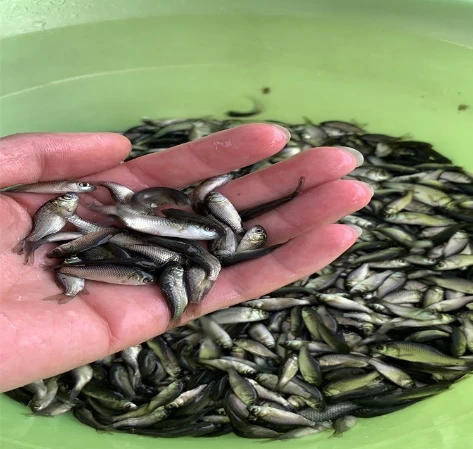
A handful of small fish fry held in one hand, a whole basin of fry behind. Fluctuations in stocking volume will determine market conditions six months from now. Here are three practical points for Guangdong fish farmers:
1. Don't be intimidated by "production growth," but don't let it lull you into complacency. 4.27% is the national average; for specific species, some are seeing increased production, while others are experiencing reduced production. When looking at data, focus on the species you're raising.
2. The species currently experiencing price increases are essentially making up for the reduced production of the past two years. Following others' profits and expanding production will likely result in buying at the peak of the cycle. Whether to expand depends on stocking data, not current pond prices.
3. From the fourth quarter to next year, monitoring stocking is more useful than monitoring prices. Those varieties that saw a significant reduction in fry stocking this year will have a stronger market position in the second half of next year.
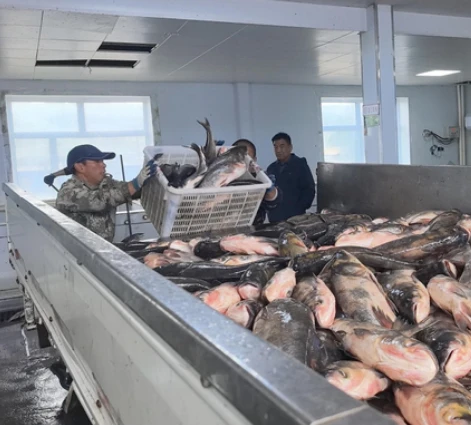
Workers are transferring live, large fish from storage baskets into transport containers.
With pond stocking tightening, the competition for fish at the distribution end is most evident.
The trend of increasing fish production is a long-term one in this industry, unavoidable. What can be avoided is: remaining clear-headed when others are frantically expanding production, and carefully calculating your own profits when others are reducing production and leaving the market.