A recent analysis report released by the National Weather Service Climate Prediction Center, part of the National Oceanic and Atmospheric Administration (NOAA), states that the El Niño phenomenon, currently causing global climate anomalies, has a high probability of reaching unprecedented intensity. Sea surface temperatures in the central and eastern equatorial Pacific are rising continuously and are expected to peak around November or December, with an 81% probability of a super El Niño event. This event is characterized by its rapid development, high intensity, and significant climate impact. Researchers are currently reviewing the events of 2015 and 2016, when a Pacific heatwave combined with a strong El Niño event caused turmoil for some of the most important commercial fishing fleets on the West Coast. Malin Pinsky, professor of ecology and evolutionary biology at the University of California, Santa Cruz, stated: "We may face a similar situation again, or even worse. I think the next El Niño event is very likely to break global temperature records, which is very worrying and will have a huge impact on marine fisheries."
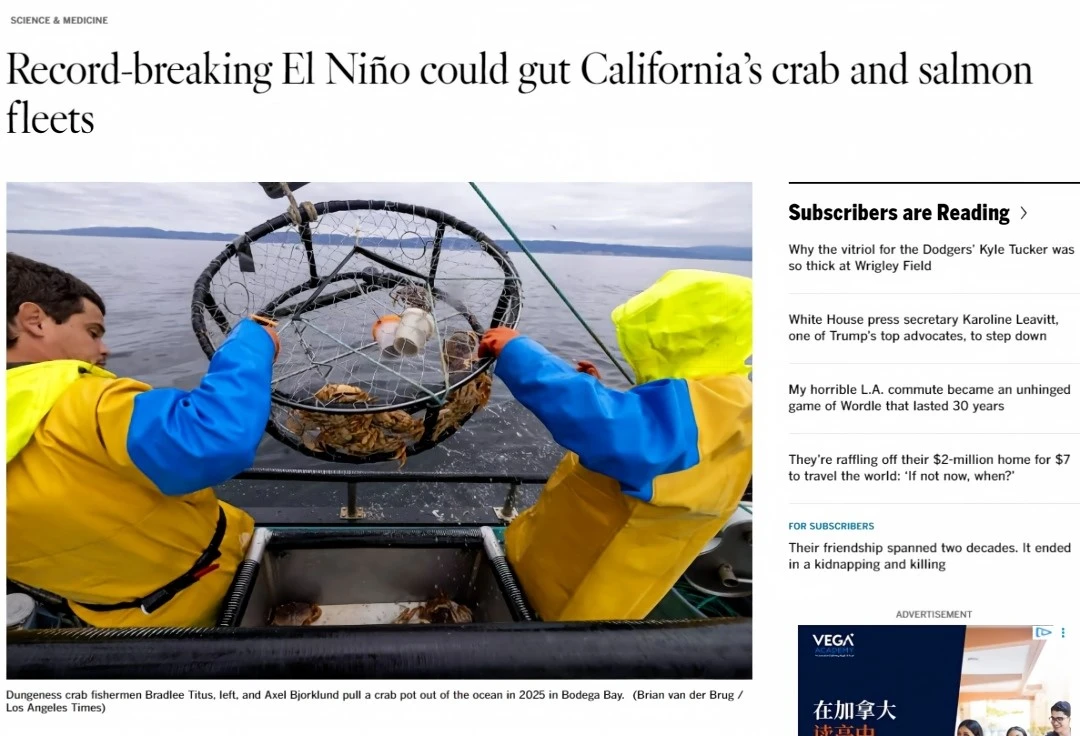
The "strongest El Niño in history" is approaching. El Niño is determined by monitoring sea surface temperatures in a specific rectangular area of the Pacific Ocean. The latest forecasts mean that this year's warming will exceed the magnitude of the most severe El Niño events in modern history-namely, 1982-83, 1997-98, and 2015-16. Sea surface temperatures in parts of the Pacific are 2 degrees Celsius higher than normal, while temperatures in the central ocean are 1.4 degrees Celsius higher. As the seawater warms, local marine life is reacting. Some species are dying, some are unable to reproduce, some are migrating north, and others are swimming into deeper waters. Furthermore, some organisms are becoming sick or more susceptible to pathogens due to the rising temperatures. Pinsky points out that the range of marine species is changing five to ten times faster than that of terrestrial species due to global warming. Therefore, we are seeing these rapid changes in the ocean, and our commercial fisheries have to prepare for these changes earlier than hunters or farmers on land, changes that could have catastrophic consequences for commercial fishing fleets. They have experienced declining catches in the past, but usually know exactly when and where fish are still available. El Niño's core is the rise in ocean temperatures, with aquatic species being the first to be affected. Anchovy catches, particularly in Central and South America, are significantly impacted-anchovies may seem ordinary, but as a key ingredient in fishmeal and fish oil, they have a crucial influence on the global fishing economy. Sunny Jardine, a resource and environmental economist at the University of Washington, explains: "Fishing fleets often rely on a few key commercially caught species for their livelihoods. These fisheries are only open for specific periods of the year, so fishermen participate and plan their operations accordingly. If the opening is delayed or completely closed, this plan is 'severely disrupted.' For example, during the 2015-2016 fishing season, Dungeness crabs in California waters were infected with a harmful bloom of pseudonitrate algae (Pseudo-nitzschia). Therefore, in 2015-2016, regulators postponed the crab fishing season by several months, ultimately compressing what would normally be a seven-month season into about two months." During this dismal fishing season, 71% of California Dungeness crab fishing vessels ceased operations, resulting in the loss of over 200 jobs. She noted that during that period, some fishermen chose to wait, others switched to catching other fish species, and larger, financially stable fleets were able to sail further north in search of crabs. With a potentially record-breaking El Niño event in 2026 following a massive coastal heatwave, and fuel prices remaining high, even large fishing fleets may have to reconsider how much effort they are willing to invest in fish hunting.
California's commercial fishing industry may suffer a "devastating" blow. In California, the warming of ocean waters caused by El Niño is affecting more than just the Dungeness crab fishing industry. For example, during a previous El Niño, the California market squid (Doryteuthis opalescens) fishery, then California's largest commercial fishery, was severely impacted and has yet to fully recover (the squid population has migrated north to Oregon). The salmon fishing industry has also been affected, partly due to drought impacting inland rivers. These rivers are spawning grounds for tuna and sockeye salmon, after which the fry migrate downstream to the ocean. However, some studies have analyzed data from 1948 to 2018 on the shift of the geographic center of El Niño from the eastern tropical Pacific (EP) to the central tropical Pacific (CP) in the 21st century. These studies found significant changes in the impact of El Niño pattern changes on catches. While the traditional EP-type El Niño significantly reduced squid catches in the 20th century, this impact has gradually weakened in the 21st century with the strengthening of the CP-type El Niño. It is noteworthy that the CP-type El Niño is a specific variant, primarily warming in the central Pacific, typically weaker but more frequent, and may even be somewhat beneficial to the reproduction of California squid populations. However, overall, a decline in California squid populations and northward migration remain highly probable. Current scientific forecasts indicate that the strong El Niño event expected in 2026 will have a complex and dual impact on California's squid fishery. In the short term, it may negatively affect California's local catch, but in the long term, it could also create new fishing opportunities in more northerly waters, such as Oregon and Washington. Fisheries management agencies should consider adaptive measures to address the ongoing evolution of El Niño's effects.